
Imagine this… You are on a remote island in the North Pacific Ocean. The sunsets are beyond “Instagram-worthy”. There’s something very special and sacred about the place. You have an urge to protect it by keeping it a secret. There are no resorts, but there is a beautiful community, with descendants of the Island’s Custodian’s who have looked after the land and its waters since time immemorial. This is a place you only read about in fiction or a last frontier travel article. A place untrodden by a tirade of tourist footsteps and associated destructions. This place has somehow been suspended in a moment in time.
At sunrise, there are around thirty green sea turtles gently grazing on the seagrass. There’s a slight breeze but no swell. After a while, you kind of get used to the surroundings. The turtles somehow become normal for a short time. Like when you’re back home, it’s not out of the ordinary to see the sheep, cattle or kangaroos grazing. The funny thing about being human is, it doesn’t take long for what’s initially foreign to quickly become normal. But how could it be? Thirty iconic turtles you’ve only seen in books or on TV dipping and grazing only a few metres from where you stand? That’s impossible! It was one of the most special experiences, and while the image of those turtles will never leave me, it’s what’s on the northern side of the island that’s been branded in my mind forever.
Have you ever been in a foreign land and seen something that just takes your breath away? When time stands still and you know that something has just shifted, a culture shock, and you’ll never be quite the same again? That’s what happened when local Elder and friend Lazarus took my colleagues and I to the other side of the island. The side passed by the North Equatorial Current within the system of the North Pacific Gyre. One of the currents that moves across the North Pacific and gathers tonnes of plastic in its path. Carrying it for thousands of kilometres and depending on the wind and tides, bringing some of it to land on Lazarus’ and his community’s island.
The current isn’t discriminate; it carries all kinds of bottles, ropes and extraordinary items; plastic bottles and thongs are the most common to land on the beach of his island paradise and home. Lazarus (pictured below), who was once a Ranger, explains that the plastic started to arrive in the early noughties. Back then there was only a bottle or two here and there, but now, it’s a completely different story. Not knowing what to do, where to store or dispose of the waste, he has created a giant installation. An expression and statement of defiance and desperation, made up of thousands of bottles, caps and what he calls slippers. There are other things as well, including strips of rubber he bends into the shape of a heart in the sand.
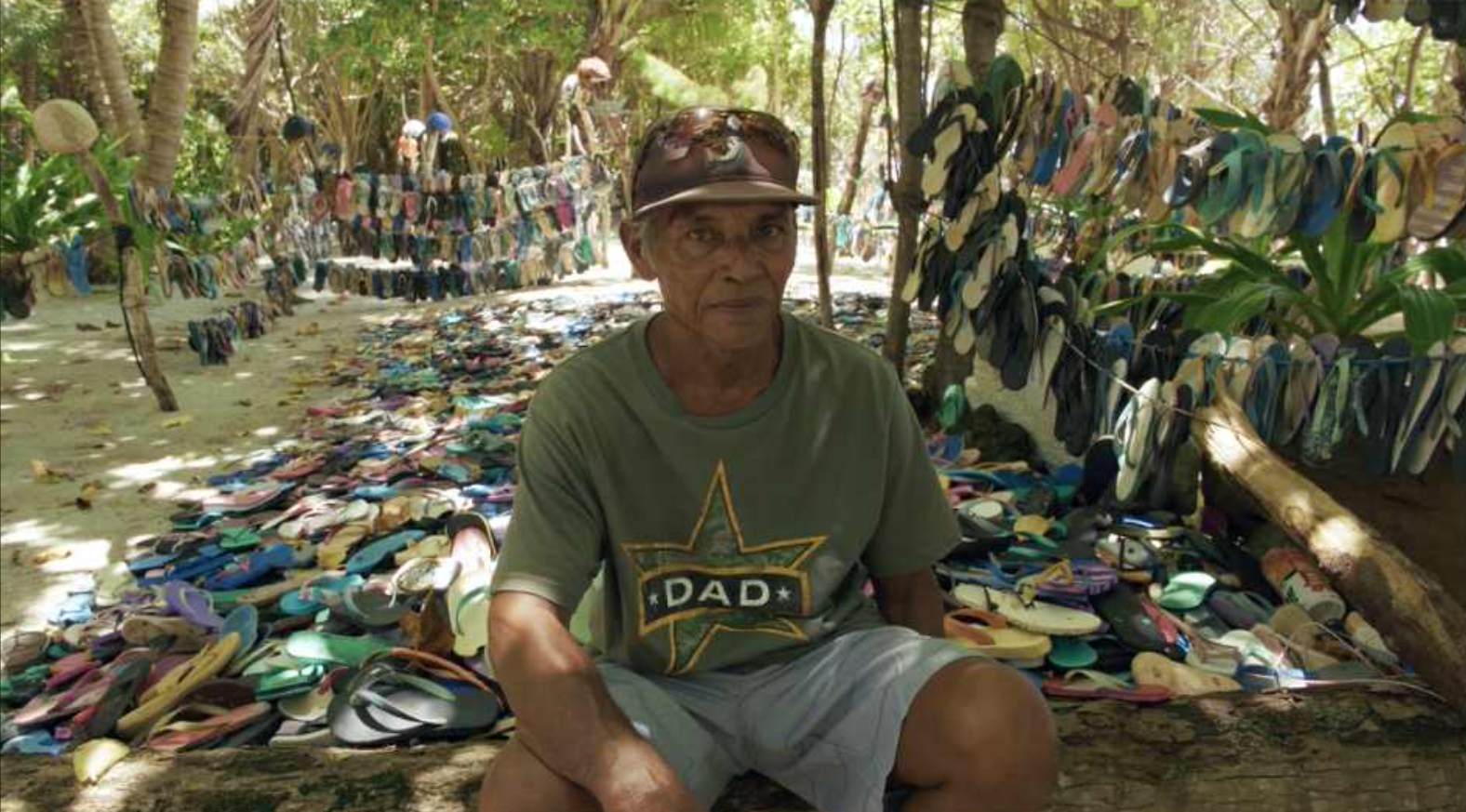
When we had the privilege of visiting this place it was to document the issue of plastic being faced by Pacific Island Nations. One of the most vulnerable groups that face a tide of plastic pollution on land and in the sea. When we were tasked with the project you think you know what you will experience, but nothing can prepare you for what you see. Lazarus admitted to us his installation is a desperate cry for help because he doesn’t know what else to do and he doesn’t have a seat at the boardroom tables who manufacture and distribute plastic products across the world.
Right now, as the tides rise and fall, and the ocean keeps lapping on that shore, you can be sure that so is a new wave of foreign plastic arriving. The seen and unseen. The macro and micro. And also right now, as you read this, the world is gathering in Geneva, Switzerland at the sixth intergovernmental negotiating committee meeting to establish a framework to address the entire life-cycle of plastic. A framework which was called for by Fiji and supported by other Pacific Island nations, then a large portion of the world. Why? Because they are drowning in the stuff! Because they make a small percentage of plastic, yet endure the burden which enters the islands via transboundary currents and consumer goods, and almost never leaves! In the negotiating rooms there are two sides. Those who want the status quo because any change will adversely impact their economies… or so they say! The other side is made up of 100 Countries, including some of the world’s smallest, who are standing up and standing together in an attempt to stem the tide of plastic on behalf of all 8 billion of us!
This week, the Trump Administration sent a memo urging Countries to reject plastic pollution caps in the UN Treaty. The same man who called for the reintroduction of the plastic straw because paper just doesn’t cut it when he is sucking his soda!
The oil-producing nations have also worked to block and dilute the process and outcomes since the process began. You don’t have to be a rocket scientist to understand why, but I ask, what about Lazarus who’s thousands of kilometres away caring for his Country and picking up plastic with nowhere to put it? And what about the microplastics in the ocean, ice caps and air? The nano plastics from car tyres, nappies and our clothing amongst other things. Or the research linking the 16,000 chemicals in plastic to cancer, endocrine and fertility disruptions amongst other health issues? Do they not count because of bottom lines and soft drink?
Today is day six of the Treaty negotiations. It’s also the eighth of the eighth. Lions Gate. A date aligned with significant astral positions and a date we are encouraged to dream and manifest. If that’s the case, I dream of a world where Lazarus, the turtles, the seagrass and all of us matter. I dream of a moment in time when those in ivory and oil towers realise their power and capacity to make a decision which will change the outcome in favour of all of us. The ones here and the ones to come. That our value is greater than any fiscal outcome.
Make no mistake, we are in the middle of an existential crisis with no benchmark in history to look back on or measure from. No one really knows the full effects of what is going on or the level of health impacts we are enduring, let alone our animal life and environments.
When I was a little girl, my Grandfather warned me plastic would choke the earth. It set in train a perspective and fear I have carried through my adult life to date, and unfortunately his prediction is coming to pass. So please, we call on you, the ones making the decisions on behalf of all of us, to meet the scale of this borderless crisis with the weight of your courage to protect us and the generations to come. And to anyone reading this, no matter your background or position, please pray, pray with all your might that the people in the room in Geneva find a way to get a strong Treaty through.